
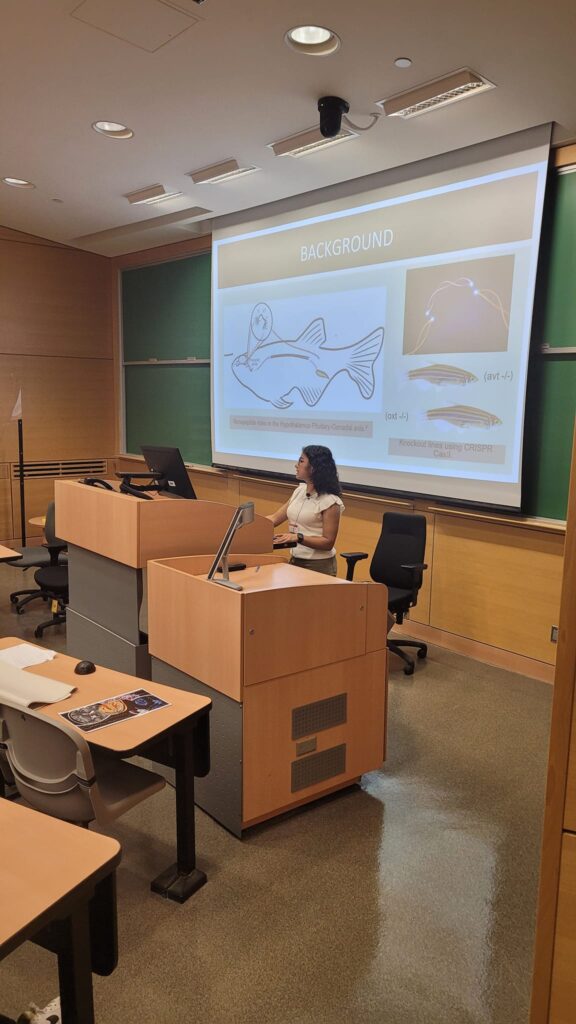
Nonapeptides oxytocin (oxt) and arginine vasotocin (avt) are evolutionarily conserved in vertebrates and have arisen through an ancestral vasotocin gene duplication. Taking advantage of recently generated homozygous zebrafish knock-out lines (KO) for oxytocin (oxt -/-) and arginine vasotocin (avt -/-), the author tested preliminary findings that avt -/-, but not oxt -/-, KO affects reproductive success in a female-specific manner. There is a significant reduction in the average number of eggs spawned in the avt -/- line 2, but not oxt -/- line 2, compared to the wildtype (wt). Furthermore, mating trials with WT backcrosses make it evident that this is a female-specific effect, because male avt -/- crossed with female WT exhibited normal spawning success, while female avt -/-crossed with male WT produced a reduced number of eggs like the double KO mating results. This affect does not appear to be mediated by AVT-dependent changes in reproductive behaviour, as indices of courtship behaviour in line 2 avt -/- females are not different from wt. Histological data shows that the effect is furthermore linked to female egg maturation than release, as avt -/- lines have a premature arrest in the egg maturation stages 2-3. This is further corroborated at the gene expression level as nanos2, a primordial germ cell marker, does not exhibit different ovarian transcript expression between WT and avt -/-, suggesting a similar reservoir of germ cells. Conversely the expression of the luteinizing hormone receptor lhr revealed a significantly reduced expression in ovaries of avt -/- females, suggesting that decreased peripheral responsiveness to LH may contribute to the female reproductive phenotype in this KO line. Together, these data support a role for vasotocin in the female male zebrafish reproductive physiology and success, which has implications for aquaculture and ecotoxicological research.
Download entire Presentation from here.
Keywords: Nonapeptides, Zebrafish, Double KO, Vasotocin, Oxytocin
Author: Kusum Sharma
Department of Biology, University of Ottawa, Ottawa, Canada