
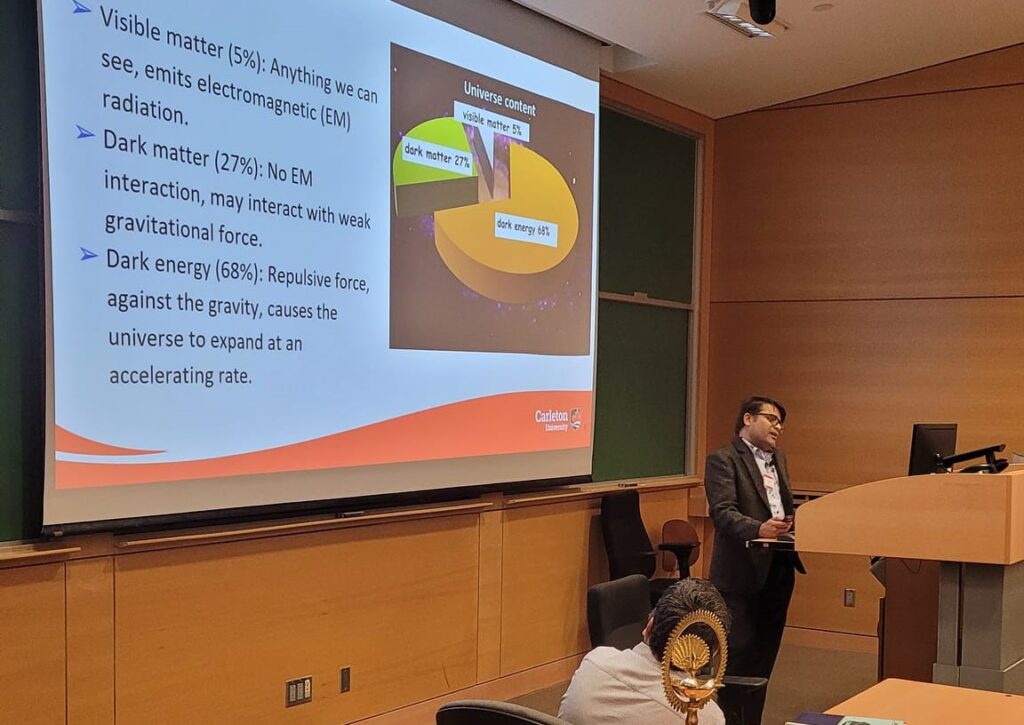
Various astronomical observations indicate that more than 80% of the Universe is made up of non- luminous and invisible object called dark matter. Numerous fundamental particles have been proposed as candidates for the dark matter such as axions, sterile neutrinos, neutralinos, supersymmetric particles, and Weakly interactive massive particles (WIMPs), but no conclusive signal has been seen despite global efforts of available resources and technologies. There are three directions to detect these hypothetical particles: production of dark mater in accelerators, indirect detection of elements in cosmic rays (CRs) due to the annihilation of dark matters, and directly detect dark matter interaction in the underground particle detectors.
The major challenges for dark mater detection are background in the detector and surroundings due to alpha and gamma radiation present in detector materials and environmental cosmic ray. The background and signal discrimination are highly developed by machine learning and computational advancement so, many direct detection experiments such as DEAP, XENON, Darkside, COSINE give large constraint on direct detection of dark matter. This presentation will give an overview of current, and future experiments that are looking for direct evidence of Weakly interactive massive particles (WIMPs) dark matter, possible discovery and its impact on our understanding about the Universe we exist.
Keywords: Dark matter, WIMPs, Particle detector, Alpha radiation, Cosmic ray
Author: Pushparaj Adhikari
Research Associate, Carleton University, Ottawa, Canada